
Declutter your digital life to calm your mind and body
This page is designed to help you notice how digital clutter is affecting your focus, stress levels, and sense of calm.
This guide isn’t theory. It’s shaped by years of coaching sessions, real conversations, and the practical shifts that people tested until they found what actually works.
Decluttering your digital life doesn’t mean becoming a minimalist monk with exactly 12 files and one inbox folder called “Zen.”
It means reducing the background noise that constantly pulls at your attention so your brain can finally exhale.
Most people underestimate how much mental energy their digital environment demands. Every unread email, cluttered desktop, bloated photo library, and chaotic app screen quietly asks your brain to make a decision. Ignore it? Deal with it later? Try to remember what’s important? That low-level tension adds up.
Meeting this goal looks like creating digital spaces that support you instead of draining you.
In real life, this might mean:
Opening your email and immediately seeing what matters, not 47 newsletters you meant to unsubscribe from three years ago.
Knowing where files live so you’re not re-downloading the same document or texting yourself screenshots “just in case.”
Having fewer notifications, fewer apps grabbing at your attention, and fewer digital piles whispering, “You’re behind.”
Sitting down at your computer or phone and feeling calmer instead of instantly overwhelmed.
This isn’t a productivity upgrade. It’s nervous system support disguised as file management (a sneaky but effective combo).
Jasper’s story (with permission)
When Jasper came to coaching, he was convinced his job was the problem. He felt constantly stressed, behind, and mentally exhausted. His days were full, his to-do list never seemed to shrink, and he ended most afternoons feeling like he’d worked hard but accomplished very little.
At first glance, it looked like classic work overload.
But when we slowed things down and took a closer look, a different pattern emerged. Jasper wasn’t drowning in work. He was drowning in how that work lived digitally.
His email inbox was overflowing. Important messages were mixed in with low-priority ones. Teams messages came in faster than he could respond, and there was no system for tracking which conversations actually needed follow-up. Project files were scattered across folders, downloads, and shared drives, so he was constantly searching, reopening, or recreating things he’d already done.
Every time Jasper opened his computer, his brain went into alert mode.
Once we identified that the issue wasn’t workload but organization, everything shifted. We focused on building simple, realistic systems for email, messages, and project files. Nothing fancy. Nothing perfect. Just clear places for things to live and clear rules for what needed attention and what didn’t.
The result was almost immediate. Jasper’s stress dropped noticeably, even though his workload stayed the same. He felt more in control, more focused, and far less reactive during the day.
His biggest realization was this: “I thought I needed less work. What I really needed was less chaos around the work.”
That’s what digital decluttering makes possible. It doesn’t remove responsibility, but it removes unnecessary pressure so your nervous system isn’t doing overtime just to keep up.
Why you should clean up your digital life
Share this guide on Pinterest.
Digital clutter keeps your brain in a constant state of alert. Even when you’re not actively engaging with it, your mind tracks unfinished digital tasks the same way it tracks unfinished physical ones.
When your digital environment is chaotic:
Your attention gets fragmented.
Your stress baseline rises.
Your ability to rest, focus, and think clearly drops.
Cleaning up your digital life helps your nervous system distinguish between real urgency and background noise. It creates fewer micro-decisions, fewer interruptions, and more mental breathing room.
And no, you don’t need to declutter everything to feel the benefit. You just need enough order to stop constantly scanning for what you’ve forgotten.
You might be thinking
-
What this usually means
Digital clutter builds invisibly. Files pile up one download at a time. Emails sneak in through subscriptions. Photos multiply without permission. When everything feels messy, your brain shuts down instead of choosing a starting point.Quick wins
Pick one category only (email, photos, or desktop) and ignore the rest for now.
Set a 20-minute timer and stop when it ends.
Why this works
Limiting the scope reduces overwhelm. Your brain can engage when the task feels contained and survivable (key detail). -
What this usually means
You’re waiting for the perfect window that never arrives. Digital clutter thrives in “later.”Quick wins
Tie digital decluttering to an existing habit (coffee, Sunday reset, end-of-day shutdown).
Choose a repeatable 10-minute block instead of a big session.
Why this works
Consistency beats intensity. Small, regular cleanups prevent re-accumulation and build trust with yourself. -
What this usually means
Perfectionism and fear of loss are running the show. Digital clutter often acts as emotional insurance.Quick wins
Create a “review later” folder instead of deleting right away.
Archive instead of erase when unsure.
Why this works
It reduces emotional resistance. You don’t need certainty to make progress, just a safety net. -
What this usually means
You’ve normalized constant noise. Many people don’t realize how much tension they’re carrying until it lifts.Quick wins
Notice how your body feels when you open your inbox or phone.
Remove just one recurring annoyance (one app, one notification type).
Why this works
Awareness precedes motivation. Once your nervous system feels the difference, momentum follows.
Where to start

Reflection exercise
Before changing anything, get clear on what’s actually happening for you.
Describe your current reality
What does your digital life feel like day to day? Where do you feel tension, avoidance, or frustration? What do you keep ignoring because it feels too big or annoying?
Helpful cues:
What do you dread opening?
What steals your attention without giving much back?
What feels cluttered but “fine enough” to avoid?
Describe your ideal
Imagine your digital life working for you instead of against you. What feels easier? What feels calmer? What would support your focus, not fracture it?
Helpful cues:
What would feel quieter?
What would take less effort?
What would help you rest better?
Do you want support with this?
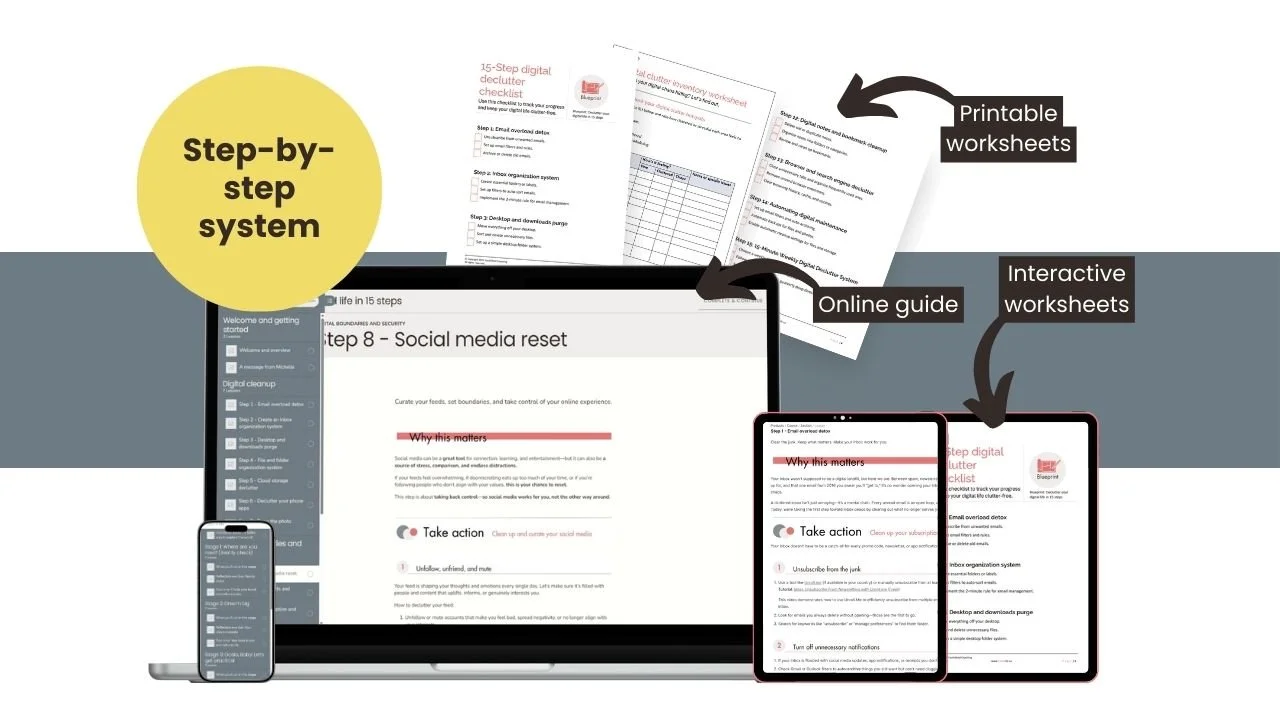
Make lasting change with the course: Declutter your digital life in 15 steps
When this is right for you: You know surface-level cleanups aren’t enough anymore. You want a clear, structured plan that helps you organize email, messages, files, and digital inputs in a way that actually sticks, without aiming for perfection.
How this can help: This course walks you through digital decluttering step by step, helping you build simple systems that reduce stress instead of adding rules. You’ll learn how to organize your digital work so your brain isn’t constantly scanning, searching, or bracing for what you’ve missed, even when your workload stays the same.

Get personalized support with one-on-one coaching
When this is right for you: You’ve tried tips, challenges, or systems before and they didn’t stick because your situation isn’t generic. Your work tools, responsibilities, and mental load are specific, and you want help untangling your version of digital overwhelm, not someone else’s.
How this can help: In one-on-one coaching, we look directly at how your digital life is set up and how it’s affecting your stress, focus, and energy. Together, we identify what’s creating pressure, design simple systems that fit the way you actually work, and adjust them in real time so they’re sustainable. This isn’t a one-size-fits-all reset. It’s practical, personal, and designed to calm your nervous system, not give it more rules to manage.
FAQ - Questions my clients ask
-
Digital clutter keeps your brain in a constant state of low-level alert. Every unread email, open tab, and scattered file creates another unfinished loop your mind feels responsible for tracking. Even when you’re not actively working, your nervous system stays engaged, which can lead to mental fatigue, irritability, and difficulty focusing or relaxing.
-
Start with the area that causes the most friction in your day, not the one that feels “most correct.” For many people, that’s email or work messages. Choose one small, contained category and give yourself a short time limit. Progress comes from reducing chaos in one place, not fixing everything at once.
-
Long-term organization comes from simple systems you can remember and maintain, not elaborate setups. Clear folder names, consistent habits for saving files, and short, regular reset sessions work better than big cleanups you never repeat. The goal is to make your digital spaces easier to use, not perfect.
-
Yes. The 15-Day Digital Declutter Challenge breaks the process into small, daily actions that fit into real life. Each step helps you reduce digital noise without overwhelm, so you can feel calmer and more in control without needing a full digital overhaul.
You might also like…








When it comes to starting a side hustle, there are a few common mistakes that can slow you down, waste your time, or even make you want to quit.