
Start a side hustle to earn extra money while working full time
This page is designed to help you notice whether a side hustle makes sense for you and what starting one could realistically look like alongside full-time work.
This guide isn’t theory. It’s shaped by years of coaching sessions, real conversations, and the practical shifts that people tested until they found what actually works.
A side hustle is a way to earn extra money outside your main job, without quitting, risking your stability, or turning your life upside down.
Most people imagine a side hustle as a second full-time job in disguise. That picture stops them before they start. A healthy side hustle is contained. It has clear edges around time, energy, and expectations. You decide how many hours it gets. You decide what you will and won’t do. You decide what success looks like in this season.
It might look like freelancing a few hours a week, selling something you already know how to make, offering a service people regularly ask you for, or testing a business idea on a limited schedule. The key detail is that it fits around your existing responsibilities instead of competing with them.
Samuel's story (with permission)
When Samuel came to me, he wasn’t unhappy with his job in the usual way. He was bored, yes, but he also valued what the job gave him: a steady paycheck, solid benefits, and predictability he didn’t want to lose.
He kept circling the idea of a career change, assuming boredom meant something was wrong. But every option we explored felt risky or exhausting. Starting over didn’t actually solve the tension he was feeling.
Once we slowed the conversation down, a different pattern showed up. Outside of work, Samual spent a lot of time learning, planning, and thinking about preparedness. He followed forums, tested systems, and genuinely enjoyed helping friends think through "what if" scenarios. This wasn’t a vague interest. It was something that energized him.
Instead of forcing that passion into a full career pivot, we looked at how it could live beside his job. We brainstormed practical ways to turn what he already knew into something useful for others, without sacrificing stability. What he kept coming back to was teaching preparedness to people who genuinely wanted to learn, not in a doomsday way, but in a calm, practical, skill‑building way.
Samual didn’t quit his job. He didn’t burn bridges. He created a side hustle that gave him creative energy, a sense of purpose, and extra income, while his main job continued to provide security.
What changed wasn’t his employment status. It was how trapped he felt. The side hustle gave him an outlet for what mattered to him, without asking him to gamble with his livelihood.
Why you should start a side hustle while working full-time
For many of my clients, the deeper reason they want a side hustle isn’t just money. It’s a relief from constant financial pressure. When income only comes from one place, every unexpected expense feels heavier. A side hustle creates another option. Even a small stream of extra income can cover a bill, rebuild a buffer, or reduce reliance on credit. That flexibility lowers stress and restores a sense of control when work feels stagnant or limiting.
If you’ve been toying with the idea of starting a side hustle but keep brushing it off, let me ask you this: why not now? The idea of balancing a full-time job with a side business might seem overwhelming at first, but the benefits far outweigh the challenges. In fact, it could be one of the best decisions you make for your future.
Here’s why starting a side hustle while holding down a full-time job can be a game-changer.
Extra income (who doesn’t want that?)
Let’s start with the most obvious perk: more money. Whether you’re trying to pay off debt, save for a big purchase, or just add a little breathing room to your budget, a side hustle gives you that extra financial cushion. It’s nice to have something coming in that’s not tied to your 9-to-5.
What’s even better? You’re not putting all your financial eggs in one basket. If your main job hits a rough patch (fingers crossed it doesn’t), your side hustle is there as a backup. And as you build it, that extra income might just turn into your main source of revenue one day.
Share this guide to Pinterest.
Turn your passion into profit
We all have hobbies and passions that, let’s be honest, we wish we had more time for. A side hustle lets you turn that passion into something that pays. Love writing? Start freelance blogging. Obsessed with photography? Offer event or portrait sessions. Whatever your interests, there’s probably a way to monetize them.
And here’s the magic: doing something you love, even part-time, can bring a new level of joy and fulfillment into your life. It might not feel like “work” at all, which makes the extra hours worth it.
Build skills that your 9-5 won’t teach you
Your full-time job likely focuses on a specific set of skills. But a side hustle? It’s an opportunity to expand your skill set in ways your current role may not offer. Whether you choose to do marketing, customer service, accounting, or create content for YouTube, running your own side gig teaches you valuable skills that can actually make you better at your day job.
Plus, you’ll build a different kind of confidence; one that comes from creating something of your own from scratch. That entrepreneurial mindset can sharpen your problem-solving abilities and push you out of your comfort zone, opening up all kinds of new opportunities in your career and life.
Read: Why your 9-to-5 isn’t the problem, but your creative soul is bored to tears
Starting a side hustle is a path to financial freedom
One of the most powerful reasons to start a side hustle while working full-time is that it gives you the potential to become financially independent. Let’s face it, most of us aren’t going to get rich on a single salary.
A side hustle can grow into something much bigger than you ever imagined. Many successful entrepreneurs started their businesses on the side before taking them full-time. Think of it as planting a seed while still having the security of your full-time income. Over time, with consistency and effort, your side hustle might become your primary hustle, freeing you from the 9-to-5 grind altogether.
It’s a safety net (just in case)
In today’s economy, nothing is certain. While it’s great to have a stable job, life can throw curveballs. Companies downsize, industries shift, and sometimes, we’re left scrambling. Having a side hustle can be a safety net if things change unexpectedly.
It’s easier to manage life’s unpredictability when you have something of your own to fall back on. If your day job situation ever changes, you’ll already have an income stream that you can focus on growing.
You’ll learn better time management (yes, really)
One of the biggest concerns people have about starting a side hustle is, “Will I have time for this?” The truth is, when you’re passionate about something, you’ll find the time. And what’s amazing is that it teaches you how to manage your time like a pro.
You’ll quickly learn how to prioritize, batch tasks, and work efficiently. Surprisingly, this doesn’t just make you better at running your side hustle, it makes you better at your full-time job too. Suddenly, you’re finding pockets of time you didn’t even realize existed.
Because no one else will do it for you
Let’s be real. If you’re waiting for the perfect time to start, you’ll be waiting forever. There’s always going to be some reason not to take the plunge. But the reality is, no one else will build your dreams for you. Starting a side hustle now gives you the power to shape your own future.
Maybe it’ll stay as a small gig you enjoy after work. Or maybe, just maybe, it’ll grow into something that lets you say goodbye to your full-time job for good. Either way, you’ll never know unless you start.
Starting a side hustle doesn’t have to be a massive commitment or a source of stress. With the right planning, it’s a manageable and rewarding way to diversify your income, build new skills, and create something that’s uniquely yours. And the best part? You can do it all while keeping the security of your full-time job.
So, what are you waiting for?
You might be thinking:
-
This is one of the most common sticking points for people thinking about a side hustle, especially if they’ve never seen themselves as “entrepreneurial.” When you don’t have a clear idea right away, it can feel like a sign that this path isn’t for you, or that you’re missing some obvious insight everyone else seems to have.
What’s usually happening underneath this thought is pressure to come up with something original, impressive, or fully formed before you’re allowed to begin. When your mind jumps straight to finished products, polished offers, or businesses you’ve seen online, it’s easy to conclude that you don’t have anything worth offering.
There’s also a quieter assumption at play: that value only comes from expertise you’ve formally named or packaged. Everyday skills, lived experience, and things you’ve simply learned by doing tend to get dismissed because they don’t look like “real ideas” yet.
Quick wins:
Notice where people already rely on you. Pay attention to the kinds of questions people ask you, the problems they bring your way, or the situations where others seem relieved when you step in. You’re not deciding anything yet, just observing where your experience already shows up as useful.
Why this helps: It shifts your focus from inventing value to recognizing value that already exists in your life.Notice what feels obvious to you but confusing to others. Think about things you explain often, systems you’ve figured out through trial and error, or topics you’ve spent time learning simply because they interest you.
Why this helps: Many side hustles grow out of clarity you take for granted, not rare or advanced expertise.
Why this works
Not knowing what to sell usually isn’t a creativity problem. It’s a visibility problem. Once you start noticing where your knowledge, experience, or perspective already makes things easier for others, ideas tend to emerge naturally. Awareness comes first; clarity follows.
Tools that might help:
Book: *Side Hustle: From Idea to Income in 27 Days by Chris Guillebeau: Structured idea-to-test plan.
Book: *Designing Your Life by Bill Burnett & Dave Evans: Practical ideation + prototyping for career/offer ideas.
Book: *Show Your Work! by Austin Kleon: Easy ways to share your developing offer to attract your first customers.
-
This concern often shows up once you’ve already given yourself permission to think creatively. Instead of feeling stuck with nothing, you suddenly have options, and that can feel just as paralyzing. Each idea seems possible. Some feel exciting. Others feel practical. A few feel like they should be the right choice.
What makes this overwhelming isn’t the number of ideas. It’s the pressure to choose the right one. When every option feels like it could shape your future, choosing can feel risky. Picking one idea starts to feel like closing the door on all the others, which makes hesitation feel safer than commitment.
There’s usually an unspoken belief underneath this: that the first choice needs to be permanent or optimal. If you assume your starting point has to be perfect, it makes sense that you’d freeze instead of move.
Quick wins:
Notice which ideas feel heavy versus light. Pay attention to how your body responds to each idea, not just how they sound on paper. Some ideas create tension because they come with imagined expectations, timelines, or pressure. Others feel simpler or more contained.
Why this helps: It separates ideas that drain you from ideas that feel workable in real life, which is often more important than which idea sounds best.Notice which ideas solve a problem you already see. Look for ideas that connect to situations you already understand, rather than ones that require you to invent a whole new world.
Why this helps: Starting with familiar problems reduces cognitive load and lowers the emotional risk of beginning.
Why this works
Too many ideas don’t mean you’re unfocused. They usually mean you’re capable and curious. When you remove the expectation that your first choice has to be your forever choice, it becomes easier to treat ideas as starting points instead of commitments. That shift alone often restores momentum.
Tools that might help:
Book: *The $100 Startup by Chris Guillebeau: Great for seeing how people turned simple ideas into income with very little upfront investment.
Book: *Start with Why by Simon Sinek: Helps you think about your deeper motivation for picking one idea over another.
Podcast: Side Hustle School(Chris Guillebeau): Daily short episodes where each story begins with someone picking an idea and trying it.
Podcast: How I Built This (NPR, Guy Raz): Inspiring origin stories (a bit bigger in scale, but helpful for seeing how small beginnings lead somewhere).
-
This fear tends to show up for people who already manage a lot of responsibility. When your time and energy are limited, the idea of investing them in something uncertain can feel irresponsible. Failing doesn’t just mean disappointment; it can feel like proof that you should have known better.
What’s often underneath this concern is the assumption that effort only counts if it leads to a clear, successful outcome. When success is narrowly defined, anything short of that gets labeled as wasted time. That makes the risk feel higher than it actually is.
There’s also a practical fear here. You may have seen people pour time into side projects that went nowhere, or you may have tried something yourself that fizzled out. Those experiences make caution feel wise, not pessimistic.
Quick wins:
Notice how you define “failure.”
Pay attention to what outcome you’re using as the measuring stick. Is failure tied to income, growth, or longevity? Or is it tied to learning, clarity, or skill-building?
Why this helps: When failure is narrowly defined, almost any early effort feels risky. Expanding the definition lowers the emotional stakes without lowering standards.Notice what you’d gain even if nothing “takes off.”
Think about skills you might practice, confidence you might build, or information you’d gather simply by trying something small.
Why this helps: Seeing effort as informative rather than performative reframes time spent as useful, not wasted.Why this works
Most people don’t regret trying something small and contained. They regret waiting, wondering, and carrying the question forward. When you shift from “Will this work?” to “What will this show me?”, the fear of wasting time loses much of its grip.
Tools that might help:
Book: *Feel the Fear and Do It Anyway by Susan Jeffers: Practical strategies for moving through fear.
Books: *Fail Fast, Fail Often by Ryan Babineaux and John Krumboltz: Teaches how to treat experiments as progress.
Podcast: The Mindset Mentor by Rob Dial: Short episodes on fear, motivation, and reframing setbacks. Available on Spotify or Apple Podcasts.
Podcast: The Tim Ferriss Show: Especially episodes where guests talk about failures that shaped their eventual success.
-
This is one of the most common concerns for people who are already working full time. By the end of the workday, your attention is used up, your patience is thinner, and the idea of adding anything else can feel unrealistic.
What often gets missed is that this hesitation usually isn’t about time alone. It’s about where your energy is already being spent. When work takes most of your focused effort, evenings and weekends start to feel like recovery zones, not creative ones. The thought of a side hustle can feel like asking more from a system that already feels stretched.
There’s also an unspoken assumption hiding here: that a side hustle would require large, uninterrupted blocks of time and sustained motivation. When that’s the mental picture, saying “I don’t have the energy” is a reasonable response.
Quick wins:
Notice when your energy dips and when it briefly returns. Pay attention to moments when you feel a little more mentally present, even if it’s short. This might be a specific evening, a weekend morning, or a quiet pocket after work. You’re not looking to claim this time yet, just to see where it naturally exists.
Why this helps: Energy isn’t evenly distributed across the week. Seeing where it already shows up makes the idea of “no energy at all” more accurate and less overwhelming.Notice what drains you versus what engages you. Think about tasks that feel heavy after work versus activities that hold your attention without much effort. Being fully engaged in something uses energy differently than doing something because you feel obligated.
Why this helps: Side hustles that align with interest tend to draw from a different energy source than work tasks, which changes how demanding they feel.
Why this works
You don’t need more hours in the day to begin thinking about a side hustle. You need a clearer picture of how your energy already moves through your week. When people stop assuming a side hustle must fit into their most depleted hours, it becomes easier to imagine something small, contained, and sustainable.
Tools that might help:
Article: Energy vs. time: A smarter way to structure your day by Michelle Arseneault of Intendify your life
Book: *Four Thousand Weeks by Oliver Burkeman
A grounded look at time, limits, and why trying to do everything often leads to less satisfaction, not more.Book: *168 Hours: You Have More Time Than You Think by Laura Vanderkam: Reframes how you look at your weekly schedule.
Book: *Atomic Habits by James Clear: Shows how stacking small habits leads to real results (perfect for limited-time hustlers).
Podcast: The Productivity Show (Asian Efficiency): Tips on using small amounts of time effectively.
Podcast: Before Breakfast (Laura Vanderkam): Very short daily episodes about squeezing meaningful actions into busy days.
-
Research feels safe because it means you’re just learning without risk. But too much research keeps you in planning mode forever. You don’t need to know everything before you start. You need just enough information to take the first action.
There are two types of learning:
Just-in-case learning: Collecting knowledge “in case” you need it.
Just-in-time learning: Learning only what you need for your next step.
Beginners move faster when they focus on “just-in-time learning.” For example, don’t watch 20 YouTube videos about starting a podcast. Record one episode first. Once you’ve tried doing it on your own, the next bit of research will make a lot more sense. When you run into a problem or something isn’t working, then do research on that one part.
A client I worked with spent six months researching podcasting. Finally, he just recorded one rough episode and shared it. The feedback he got in one day taught him more than hours of tutorials ever could. He’d tell you to “Just start”.
Start with these quick wins
Give yourself a research cap. Set a timer for two hours (max). At the end, you must act on what you learned (no more searching “just in case”). This prevents you from confusing endless research with real progress.
Write a “next step list.” Instead of collecting more articles, list the next two tangible actions you can take. For example: “Record one practice video” or “Draft one product description.” This shifts your brain from passive intake to active doing.
Share a messy draft. Record a rough version, make a sample, or sketch out your offer, and then show it to someone you trust. Their reaction will give you more clarity than another 10 hours of Googling.
Books worth exploring:
*The Lean Startup by Eric Ries: Teaches the principle of testing fast instead of overplanning (don’t let the “startup” word scare you; the lessons apply to side hustles).
*Stop Overthinking by Nick Trenton: Practical tools for breaking analysis paralysis.
Podcasts worth exploring:
The Minimalists Podcast: Episodes often push you to act on “enough” instead of collecting more.
Smart Passive Income (Pat Flynn): Many episodes stress starting messy and improving as you go.
-
Pricing is one of the scariest parts for beginners. You don’t want to charge too much and scare people off, or too little and feel undervalued. Here’s the thing: your first price doesn’t have to be the price you charge forever. It’s just a starting point to test the market.
The mindset shift is this: Pricing is information, not your identity. If someone says no, it doesn’t mean you’re not worth it, it just means you need to adjust something.
Beginner pricing skills:
Set a baseline. Look at what others charge for similar work.
Pick a starter price. Aim for “slightly uncomfortable but doable.”
Adjust as you go. Use feedback, demand, and your confidence to raise rates.
I once worked with a woman who started freelancing design work at $50 per project. Her first client was thrilled and even tipped her. That gave her the courage to bump her price up the next time. Bonus: She got a fantastic review from that first client which helped her get more clients. They didn’t know what the first client paid.
Start with these quick wins
Research three similar offerings. Look up what others are charging in your niche. Try Etsy shops, freelancers, or local businesses. This should give you a realistic range instead of guessing blindly.
Pick a starter price. Choose a number that feels slightly uncomfortable but not ridiculous. If you go too low, you’ll resent it; too high, and you’ll freeze. Think of it as your “practice price” that you’ll adjust later.
Ask one person directly. Share your idea with a friend, neighbor, or potential customer and ask, “Would you pay $X for this?” Real feedback (even if it’s a no) is more valuable than spending weeks worrying.
Books worth exploring:
*Freelance and Business and Stuff by Amy Hood & Jennifer Hood: Beginner-friendly guide to pricing creative services.
*The Psychology of Price by Leigh Caldwell: A simple but eye-opening look at how people perceive value.
Podcasts worth exploring:
Being Boss: Covers pricing, money mindset, and building confidence as a creative entrepreneur.
Creative Pep Talk (Andy J. Pizza): Especially episodes about valuing your work and setting prices.
*Heads-up: Some of the links on this page are affiliate links, which means I may earn a small commission if you choose to make a purchase, at no extra cost to you. I only recommend tools and resources I genuinely believe are helpful. Thank you for supporting the work I do here.
Where to start

Reflection exercise
Before you start planning a side hustle, let’s pause and think about how one might fit into your life right now, and what could feel different or easier if it did.
This reflection isn’t meant to push you toward a decision. It’s meant to help you notice where a side hustle could reduce pressure, create options, or add something meaningful to your week. Grab a notebook or open a notes app and answer these questions honestly.
Reflect on your current reality
Start with how your days actually unfold, not how you wish they did.
When during the week do you feel even a small pocket of mental space?
When do you feel most drained or stretched?
What responsibilities already take priority and can’t realistically move?
This matters because any extra income will only feel helpful if it fits into your real life, not an idealized version of it.
Reflect on where relief would matter most
Rather than focusing on income goals, think about pressure points.
What financial stress shows up most often in your day‑to‑day life?
What would feel lighter if one expense or bill were consistently covered?
How might your mood, energy, or patience change if that pressure eased?
These questions help you connect a side hustle to an improvement you’d actually feel, not just a number on paper.
Reflect on what already pulls your interest
Look for patterns:
What topics do you naturally spend time learning about or talking through?
What do people already come to you for advice or help with?
What kinds of tasks leave you feeling engaged rather than depleted?
You don’t need a finished idea yet. What matters is whether you can see a realistic way a side hustle could reduce pressure, add flexibility, or give you something engaging to work on alongside your job.
Do you want support with this?
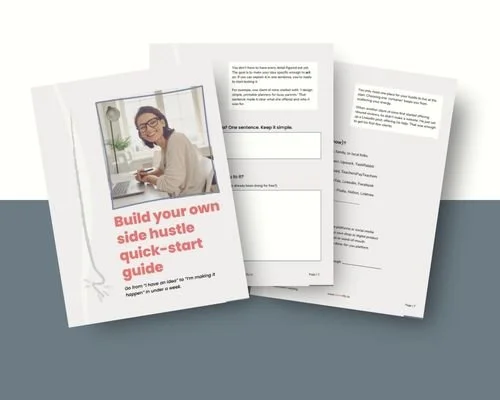
Test your idea quickly with the Build your own side hustle quick-start guide workbook.
When this is right for you: You have an idea (or a short list of them), but you keep stalling once you try to move forward. You don’t need a full blueprint yet, but you do want more direction than a blank page and good intentions.
How this can help: This workbook helps you turn a rough idea into something concrete. You’ll clarify what your side hustle could look like, how much time and energy you actually want to give it, and what your next few steps are. It’s practical, focused, and designed to stop the overthinking loop so you can make decisions and move forward with confidence.
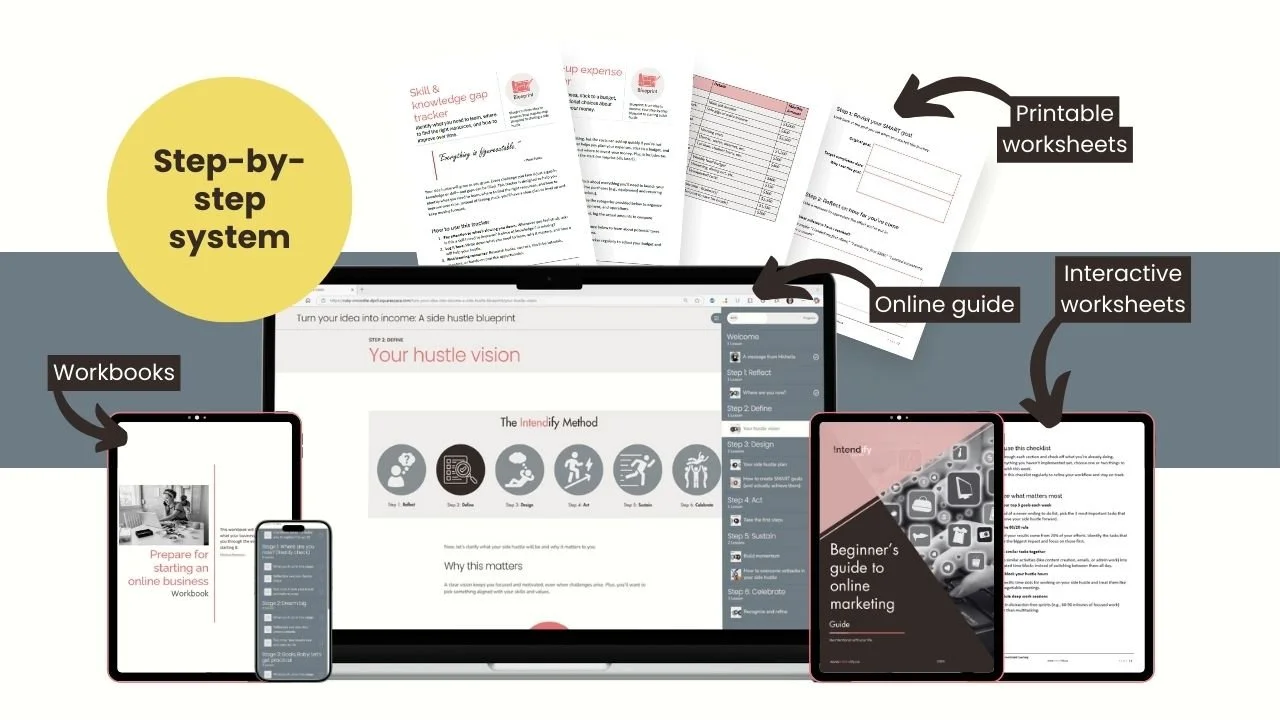
Make it real with the Turn your idea into income side hustle blueprint
When this is right for you: You’re ready to move past thinking and into planning. You’ve got some curiosity and ideas, and now you want a clear, doable structure to follow.
How this can help: This self-paced blueprint takes you from idea to early action with worksheets, examples, and a straightforward process. You’ll learn by doing, testing, and refining as you go. It’s the difference between thinking about a side hustle and actually making your first move.

Get personal support with one-on-one coaching
When this is right for you: You have an idea (or three), but you’re stuck in planning mode. You’re not sure which idea is worth pursuing, how to start without risking everything, or how to fit this into an already full life, and you want a clear path, honest feedback, and someone to help you move from “thinking about it” to actually starting.
How this can help: In one-on-one coaching, we’ll cut through the noise and focus on what makes sense for you, your skills, your time, and your goals. We’ll narrow your ideas, test them against real-life constraints, and build a simple plan you can act on right away. You’ll leave with clearer direction, practical next steps, and more confidence in the choices you’re making.
FAQ: Questions my clients ask
-
Pick the easiest to test in 7 days using skills and tools you already have. Set a 30-day experiment. Decide after 30 days to keep, tweak, or try the next idea.
-
Offer one tiny version of your service or product to one person. Think sample, trial session, or pre-order list. Keep the budget under $20 and write down what you learn.
-
Start with two 20-minute blocks. Use one for outreach or making, the other for delivery or follow-up. Consistency beats long sporadic sprints.
-
Give yourself a two-hour research cap, then take one action. Use “just-in-time” learning: learn only what you need for the next step you will take today.
-
Find the range for similar offers, pick a starter price that feels slightly uncomfortable but fair, and test it with a real person. Adjust based on feedback and demand.
-
Usually no. Test first, then formalize when you have proof of demand. Check local rules for when registration, permits, or tax collection kick in. When in doubt, ask an accountant.
-
Expect mixed feedback at the start. Treat every “no” as data. Refine your offer, your message, or your audience. Small experiments protect confidence while you learn.
-
Start with warm circles: friends, neighbors, school or work communities, local Facebook groups, and buy-sell pages. Offer a simple beta deal in exchange for honest feedback.
-
No. A simple order form, a booking link, or a social page can handle your first 5–10 sales. Build only what supports your next step.
-
Set a weekly time boundary, keep tasks small, and celebrate tiny wins. If your energy dips, pause, simplify the next step, or shorten your session length for a week.
You might also like…









When it comes to starting a side hustle, there are a few common mistakes that can slow you down, waste your time, or even make you want to quit.