
Create a healthy work-life balance by choosing and setting boundaries
This guide isn’t theory. It’s shaped by years of coaching sessions, real conversations, and the practical shifts that people tested until they found what actually works.

When balance keeps slipping away…
If you’ve ever told yourself, “Things will calm down soon,” only to realize they never really do, you’re not imagining it.
Most people don’t lose work-life balance all at once. It happens quietly. Work stretches a little longer into the evening. Messages get answered faster. Time that used to belong to you slowly gets absorbed by expectations, habits, and unspoken pressure. On paper, everything still looks fine. In your body, though, it feels heavy.
When that happens, it’s tempting to assume you need better routines, stronger willpower, or a more optimized schedule. But for many people, the real issue isn’t time management at all. It’s boundaries that were never clearly chosen, named, or protected in the first place.
This guide walks you through work-life balance from that lens, not as a perfect split between work and personal life, but as a series of intentional boundary decisions that shape how your days actually feel.
You’ll move through common thoughts people have when work starts taking over, understand what’s really underneath them, and try small, realistic shifts that help restore breathing room, without blowing up your job or your relationships.
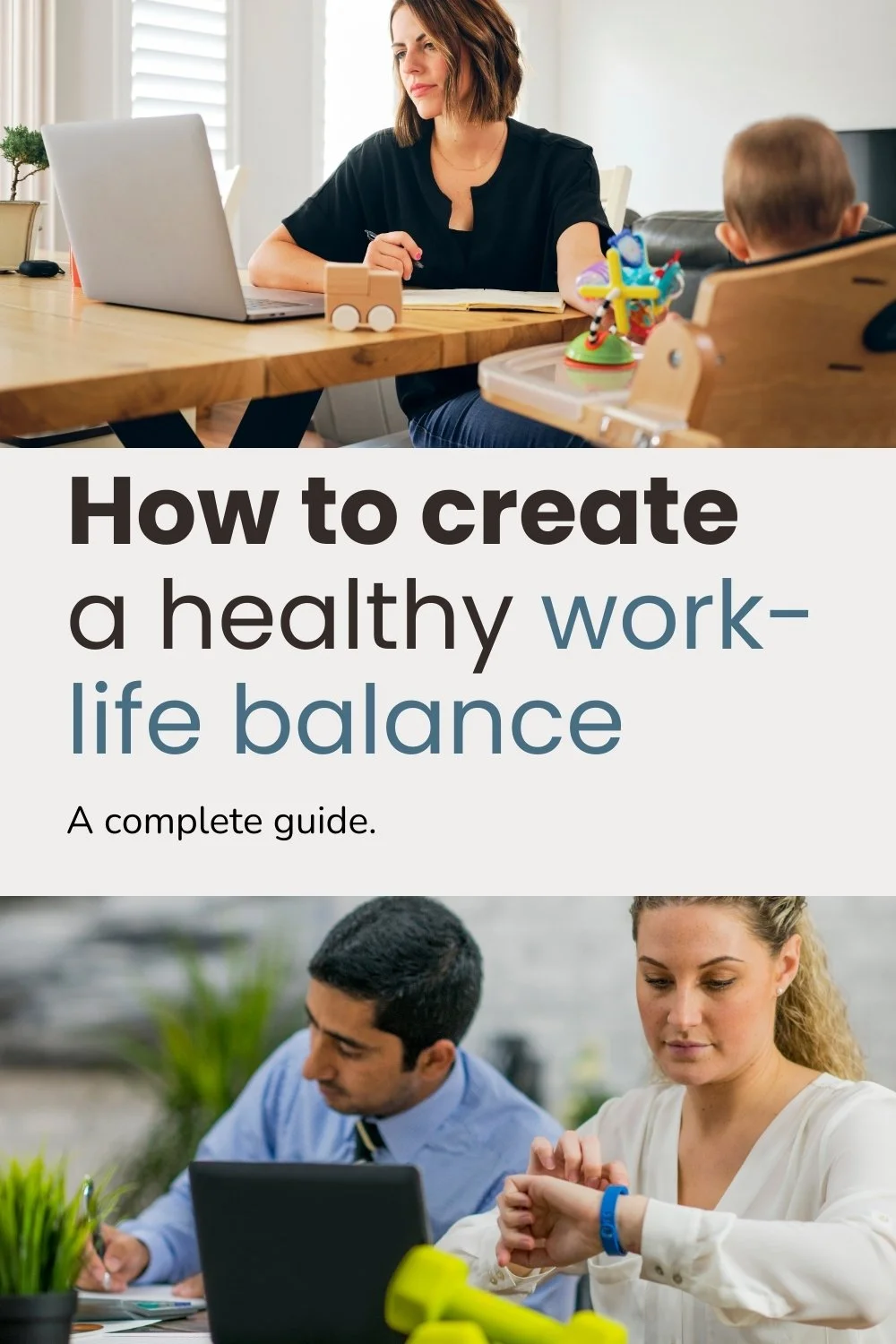
Share this guide on Pinterest.
What creating a healthy work-life balance actually means
When people hear work-life balance, they often picture a perfect split. Eight hours of work. Eight hours of personal time. Everything neatly contained.
That’s rarely how real life works.
Creating a healthy work-life balance doesn’t mean working less at all costs or forcing rigid rules that don’t fit your job or season of life. It means choosing and setting boundaries that protect your time, energy, and attention, so work doesn’t quietly take over everything else.
For one person, that might look like:
Logging off at a consistent time most days instead of “whenever things are done.”
Not checking email in bed or during family time
Taking actual lunch breaks instead of eating while answering messages
For someone else, it might mean:
Saying no to optional projects that drain them
Redefining what “being available” really means
Creating clearer start and stop points to the workday
The common thread isn’t the specific boundary; it’s the intention. You decide what matters in your life, and you shape work around that instead of letting work make the decisions for you.
When boundaries are chosen deliberately, balance stops being something you chase and starts being something you build.
Richa’s story
Richa came to coaching convinced that work-life balance just wasn’t realistic for her role. She liked her job. She was good at it. But work followed her everywhere.
Her evenings were made up of half-work and half-rest. Her weekends always felt tense because Monday was always looming. She told me, “Nothing is technically wrong, but I’m exhausted all the time.”
What made this tricky was that no one at work was explicitly demanding more. The pressure was mostly internal. She wanted to be reliable and not fall behind. She assumed that always being available was part of being professional.
Instead of trying to overhaul her schedule, we started small. She chose one boundary to test: no checking work email after dinner. She didn’t provide any explanations to her colleagues or boss. She just made that one clear (to herself) decision.
At first, it felt uncomfortable. She worried she’d miss something important. She didn’t.
What she did notice was how much mental space opened up in the evenings. Over time, that one boundary made it easier to choose others. Her energy improved. Her resentment faded. And her work performance didn’t suffer the way she feared it would.
Balance didn’t come from doing less. It came from choosing limits that supported her life.
Why this matters more than you think
When work regularly spills into personal time, it doesn’t just affect your schedule; it affects how you feel in your body and how present you are in your life.
Without clear boundaries:
Rest doesn’t fully restore you
Time off feels mentally crowded
Burnout sneaks up slowly
Over time, this can impact your health, relationships, and your sense of control. You may start to feel like your life is happening around work instead of alongside it.
Choosing and setting boundaries helps you:
Protect your energy so you’re not constantly depleted
Be more present in the parts of life that matter to you
Work from a place of control instead of pressure
This isn’t about being difficult or disengaged. It’s about creating a sustainable way to work and live.
You might be thinking:
-
Many people genuinely believe this. Your role might be demanding, client-facing, unpredictable, or tied to deadlines that don’t politely end at 4:30. When that’s the case, boundaries can feel unrealistic or even irresponsible.
What often gets missed is that no boundaries is still a choice. It’s just one that usually leads to exhaustion.
Quick win: Identify one boundary that shapes expectations instead of stopping work.
For example, adjusting your response times instead of trying to reduce your workload. This works because it changes the rhythm of work without requiring someone’s permission or a confrontation.Quick win: Notice which demands you are assuming.
Many “requirements” survive only because no one questions them. This works because drilling down on this reveals where you actually have more flexibility than you think.Why this works
Boundaries don’t need to eliminate all demands on you to be effective. Even small shifts in availability and consistency recalibrate how work interacts with your life.
Tools that might help
Book: *Four Thousand Weeks by Oliver Burkeman
A reality-based look at limits, time, and why trying to do everything makes life smaller.Podcast: The Knowledge Project (selected episodes on focus and decision-making)
-
This hesitation is incredibly common, especially for people who care deeply about doing good work. You may worry that setting boundaries will change how others perceive you or that you’ll be judged for not going above and beyond.
Often, this fear is rooted more in internal pressure than external feedback.
Quick win: Replace explanations with simple statements.
Short, neutral language reduces defensiveness. This works because over-explaining invites negotiation.
For example, say “I won’t be able to meet that deadline. I can have this ready on the 23rd.” Period. Full stop. No explaining why!Quick win: Delay your response instead of responding immediately.
You don’t need to stop helping to start changing expectations. This works because your behaviour trains others more than words.Why this works
Professionalism isn’t measured by constant availability. It’s measured by honesty, reliability, and follow-through.
Tools that might help
Book: *Set Boundaries, Find Peace by Nedra Glover Tawwab
Clear, practical guidance on boundaries without guilt or drama.Podcast: Unlocking Us (episodes on boundaries and worth)
-
When boundaries fail, people often assume they’re bad at enforcing them. In reality, most boundaries fail because they weren’t clearly chosen or supported by systems.
Trying to fix everything at once also makes follow-through harder than it needs to be.
Quick win: Choose one boundary to test for two weeks.
Treat it like an experiment, not a life sentence. This works because temporary decisions feel safer and more doable.Quick win: Write the boundary down in plain language.
Clarity reduces second-guessing. This works because vague intentions collapse under pressure.Why this works
Consistency matters more than perfection. One boundary done well creates momentum for the next.
Tools that might help
Book: *Atomic Habits by James Clear
Helpful for understanding why small, consistent changes outperform big resets.Podcast: The Tim Ferriss Show (episodes on lifestyle design and boundaries)
-
Comparison can quietly undermine your willingness to make changes. When others appear to cope better, it’s easy to assume the problem is you.
What you don’t see is what it costs them, or what they’ve quietly sacrificed to keep up.
Quick win: Stop using other people as the benchmark for your limits.
Your energy, values, and life context matter. This works because sustainable boundaries must be personal to last.Quick win: Ask what balance would look like for you, not ideally.
Focus on “better,” not perfect. This works because realistic goals are achievable.Why this works
Work-life balance isn’t a competition. It’s a calibration between your work and your life as it actually exists.
Tools that might help
Book: *Essentialism by Greg McKeown
A strong reminder that doing less, but better, creates more meaningful results.Podcast: Hurry Slowly
Conversations on slowing down in a speed-obsessed culture.
*Heads-up: Some of the links on this page are affiliate links, which means I may earn a small commission if you choose to make a purchase, at no extra cost to you. I only recommend tools and resources I genuinely believe are helpful. Thank you for supporting the work I do here.
Where to start
Reflection exercise: clarify your starting point
If work-life balance feels messy or overwhelming right now, this is not the moment to fix everything. It’s the moment to get honest about where you are and what you actually want to protect.
Before boundaries can change, they need context.
When you understand your current reality and your ideal more clearly, the next steps will get easier. Grab a notebook or open a notes app and answer these questions without overthinking them. There are no right answers here. You’re just taking inventory.
Describe your current reality
Look at how work fits into your life right now, not how you think it should fit.
When does work most often spill into personal time?
What parts of your day feel rushed, crowded, or mentally noisy?
How do you usually feel at the end of a workday: energized, drained, numb, restless?
What boundaries exist already, even loosely or inconsistently?
This step matters because many people try to set boundaries without fully seeing where the pressure actually is. Awareness turns vague frustration into something specific you can work with.
Describe your ideal
Now shift gently toward what you want more of, not a fantasy version of balance, but something realistic and supportive.
If work had clearer edges, how would your days feel different?
What time, energy, or mental space do you want to protect first?
What would “better” look like in the next few weeks, not forever?
What would you like your work to stop interrupting in your personal life?
This works because boundaries are easier to choose when they’re tied to something meaningful, not just something you want to avoid.
One small anchor to carry forward
As you move into the rest of this guide, keep one sentence in mind:
“Right now, I want to protect __________.”
It might be your evenings. Your weekends. Your focus. Your energy. Or simply the ability to rest without thinking about work.
You might also like…

When it comes to starting a side hustle, there are a few common mistakes that can slow you down, waste your time, or even make you want to quit.