
Why waiting for fun to happen never works: Start creating your own instead
This page is designed to help you recognize why fun keeps getting postponed and what that costs you.
This guide isn’t theory. It’s shaped by years of coaching sessions, real conversations, and the practical shifts that people tested until they found what actually works.

Most people don’t avoid fun because they don’t want it. They avoid it because it keeps getting pushed to the bottom of the list.
Fun becomes something planned for later, once things calm down, once the busy season passes, or once everyone else’s needs are handled.
The problem is that life rarely offers a stretch where enjoyment feels earned or justified. When a bit of extra time does appear, it usually gets filled with more responsibility, not something that actually feels good.
When fun is missing for a long time, life turns into a cycle of effort and recovery. You spend your days pushing through what needs to be done, and when you finally stop, you’re not refreshed, you’re just wiped out. Rest becomes about surviving the next day, not actually feeling better.
That’s why burnout sneaks up on people who are doing everything “right.” They’re working hard, managing responsibilities, and technically resting, but nothing in their life is giving energy back. Everything takes something out.
When you start adding small, regular moments of enjoyment, that cycle gets interrupted. You’re no longer running only on effort and collapse. There’s some relief built into your days, and that makes everything else easier to carry.
In real life, that might look like bringing back something you quietly stopped doing because it felt unnecessary or impractical. It might mean claiming a short, non-negotiable window each week that belongs only to you. Or it might mean redefining fun altogether so it matches your current energy instead of an ideal version of yourself.
When people stop postponing enjoyment, something shifts. Their days feel less heavy. They’re more patient. Responsibilities don’t disappear, but they stop taking up quite so much emotional space.
What creating your own fun actually means
Creating your own fun starts with stopping the habit of treating enjoyment as something that only happens once conditions improve.
Instead of waiting for more free time, more energy, or a better season of life, you choose small sources of enjoyment that fit into your current reality. These are things that don’t require planning weeks ahead, coordinating schedules, or feeling rested before you start.
This kind of fun is practical. It works on regular days. It’s repeatable. And because it can survive busy weeks, it actually changes how life feels over time.
At its core, this goal comes down to agency. You’re no longer letting circumstances decide whether your days feel heavy or balanced. You’re making small, intentional choices that shape how life feels now, not someday down the road.
Examples of what this looks like in real life
Share this guide on Pinterest.
It might be someone who realizes they haven’t done anything purely enjoyable in months and starts protecting a short weekly window that’s just for them, even if it’s only 15 minutes.
It might be a parent who stops waiting for long stretches of alone time and instead builds small rituals into their day that make routine tasks more tolerable or even pleasant.
It might be redefining fun entirely. Choosing something calming instead of exciting. Choosing something familiar instead of novel. Choosing something that fits your energy instead of draining it further.
The common thread is consistency. These choices aren’t special occasions. They’re woven into regular life, which is why they actually change how that life feels.
Quick reframe: Fun is not the reward
Old belief: “I’ll have fun after I finish everything.”
New truth: “Fun is part of what helps me finish anything well.”
Brent’s story (with permission)
Brent came to me because he was exhausted and frustrated, even though he was doing everything “right” on paper. He was ambitious, capable, and deeply focused on advancing his career. Most of his time and energy went into work, skill-building, and positioning himself for the next opportunity.
The issue wasn’t that he disliked his job. It was that his days were completely filled with effort. From the moment he woke up, everything had a purpose tied to progress. Even his downtime was optimized. Podcasts for learning. Articles for staying competitive. Rest only when he was too tired to keep going.
When we looked closely at what his day-to-day life actually contained, one thing was immediately clear. There was no fun in it at all. Not occasionally. Not casually. Not even in small, unplanned ways.
Brent hadn’t consciously decided to eliminate fun. He just kept assuming it would come later. After the next promotion. After the next milestone. After things felt more secure.
Instead of making a big lifestyle change, we started small. Brent mentioned that he used to bowl regularly and had stopped without really noticing when or why. We decided to bring that back in a low-pressure way. One night a week. No goals. No leagues. No turning it into another performance metric.
At first, it felt oddly uncomfortable to him. Bowling didn’t “advance” anything. It didn’t make him better at his job. It just let his brain switch off for a while.
Within a few weeks, the difference was obvious. He felt less depleted at the end of the day. He was more patient with himself and others. Work still mattered to him, but it no longer swallowed his entire sense of identity.
Nothing about his ambition changed. What changed was sustainability. Those regular nights at the bowling alley gave him enough relief that his drive stopped feeling like a slow burn toward exhaustion.
Why waiting for fun leads to burnout
When fun keeps getting pushed aside, life turns into constant output with nothing built in to recharge you.
Most people assume burnout comes from doing too much. What I see more often is people giving a lot of energy every day without anything in their week that gives energy back. Work takes something. Responsibilities take something. Even resting starts to feel like recovery instead of renewal.
Over time, that adds up. You get irritated more easily. Small tasks feel heavier than they should. Things you normally care about start to feel like obligations instead of choices.
Adding fun back into your life doesn’t solve every problem, but it gives your system a break from nonstop effort. It reminds your body and brain that not every moment requires a purpose.
When you stop waiting for fun and start creating small, regular pockets of it, work feels more manageable, patience lasts longer, and exhaustion doesn’t pile up as quickly. That’s how burnout gets prevented, through steady relief, not big overhauls.
You might be thinking
-
When someone says this, I don’t hear a lack of desire for fun. I hear a life where everything feels urgent and nothing feels optional anymore.
What this usually means
Your days are packed with responsibilities, and you’re used to putting yourself last. Fun gets pushed aside because it doesn’t feel necessary in the same way work, family, or obligations do.What helps you move past it
Stop thinking of fun as something that needs extra time. Start thinking of it as something that needs a small, protected spot in the life you already have.Quick wins
Pick one activity that takes no more than 10–15 minutes and requires no preparation. Decide exactly when it will happen this week and don’t negotiate with yourself when the time comes.
Take one routine task and make it more enjoyable on purpose, like listening to music you actually like while making dinner instead of more podcasts or background noise.
Why this works
You’re not trying to fix your schedule. You’re changing how part of your day feels, which is far more doable and far more effective.Tools that might help
Book: *The Power of Fun by Catherine Price – helps you understand why small, repeatable fun matters more than big plans
Podcast: Happier with Gretchen Rubin – practical examples of building enjoyment into real life
-
When someone feels this way, it’s usually because they’ve learned to equate being responsible with always being productive.
What this usually means
You feel guilty enjoying yourself if your to-do list isn’t finished. Rest and fun feel like rewards you haven’t earned yet.What helps you move past it
Seeing fun as something that supports your ability to handle responsibility instead of something that takes away from it.Quick wins
Put a short, enjoyable activity before a demanding task and notice how it affects your patience and focus.
Give fun a clear start and end time so it doesn’t feel like it’s bleeding into everything else.
Why this works
When fun is intentional and contained, it stops feeling like avoidance and starts feeling like something that helps you function better.Tools that might help
Book: *Burnout by Emily and Amelia Nagoski – explains why constant effort without relief leads to exhaustion
Podcast: The Lazy Genius Podcast – helps separate guilt from doing what actually supports you
-
A lot of people tell themselves they’ll enjoy life once things calm down, but in practice, there’s almost always something else demanding attention.
What this usually means
You’re waiting for permission from your circumstances instead of giving it to yourself.What helps you move past it
Accepting that life rarely slows down on its own, which means enjoyment has to be added on purpose.Quick wins
Ask yourself what kind of fun fits your life right now, not a less busy or more rested version of you.
Identify one part of your week that already feels a little lighter and protect it from being filled with more tasks.
Why this works
Fun that fits your current reality is the kind that actually happens, which is what changes how life feels over time.Tools that might help
Book: *Four Thousand Weeks by Oliver Burkeman – a grounded reminder that time is limited and waiting has a cost
Podcast: Ten Percent Happier – thoughtful conversations about presence and quality of life
-
When fun has been missing for a long time, it’s normal to feel disconnected from what you enjoy. That doesn’t mean you’re broken. It means that part of you hasn’t had much airtime.
What this usually means
You’ve spent years focusing on responsibilities or other people’s needs, and your own preferences faded into the background.What helps you move past it
Treating fun like something to rediscover gradually, not something you need to figure out all at once.Quick wins
Think back to something you used to enjoy and try it again for a short, low-pressure window, even if you’re not sure it will land.
Start with something familiar instead of new. Familiar often feels safer when energy is low.
Why this works
Small experiments rebuild self-trust and help you reconnect with parts of yourself that were set aside, not lost.Tools that might help
Book: *Designing Your Life by Bill Burnett and Dave Evans – reframes discovery as simple experimentation
15-Day Challenge: Bring the fun back (find it in the the support section below) – gentle prompts to help you explore enjoyment without pressure
*Heads-up: Some of the links on this page are affiliate links, which means I may earn a small commission if you choose to make a purchase, at no extra cost to you. I only recommend tools and resources I genuinely believe are helpful. Thank you for supporting the work I do here.
Where to start
Reflection exercise
Before you try to add fun to your life, it helps to slow down and get honest about what your days actually feel like. Not what they look like on paper and not what you think they should feel like. We’re not judging. We’re looking for patterns, okay?
Describe your current reality
Take a few minutes to think about your typical week.
How do your days feel as you move through them?
Where does your energy go, and what tends to drain it the fastest?
Pay attention to what keeps getting prioritized and what consistently falls off the list when time or energy runs short.
If it’s been a while since you’ve done anything just because you enjoy it, name that. Awareness matters here more than answers do.
Describe your ideal
Now think about a realistic version of your life that includes a bit more enjoyment. Not a perfect week. Not a vacation. Just a regular week where fun shows up in small, steady ways.
What would feel different?
Where would there be a little more breathing room?
What would you look forward to, even if it’s something simple?
Why this matters
Getting clear on the gap between how life feels now and how you want it to feel gives you something concrete to work with. It turns “I should have more fun” into a direction you can actually move toward.
Do you want support with this?
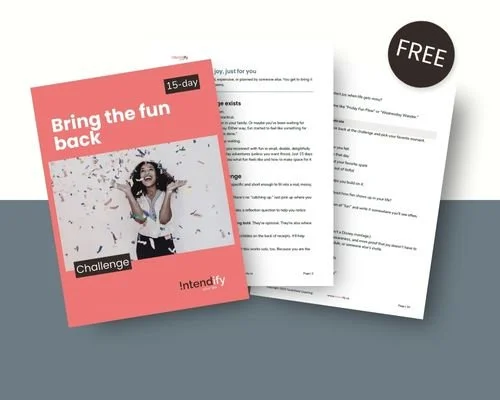
Build momentum with the free Bring the fun back challenge
When this is right for you: This challenge fits if your life feels heavy, repetitive, or all responsibility, and you know fun has quietly disappeared. You don’t want a big reset or another thing to keep up with. You just want life to feel a little lighter again without blowing up your routine.
How this can help: Over 15 days, you’ll try small, realistic ways to reintroduce enjoyment into your regular life. Each prompt is designed to help you notice what gives you energy, experiment without pressure, and stop waiting for the “right time” to enjoy yourself. The focus stays on relief, not performance, so the changes are doable and sustainable.
Make lasting change with one-on-one coaching
When this is right for you: One-on-one coaching is a good fit if you feel burnt out, disconnected, or stuck in survival mode, and you can’t see how to add fun back without everything else falling apart. You want support, clarity, and someone to help you think through real-life constraints, not just ideas.
How this can help: In our sessions, we’ll look closely at what your days actually look like, where your energy is going, and why enjoyment has slipped out. Together, we’ll design changes that fit your life as it is now, so fun becomes part of your routine instead of something you keep postponing. The goal is steady relief that makes everything else more manageable.
FAQ: Questions my clients ask
-
Because fun usually isn’t urgent. When life is full, responsibilities take priority and enjoyment gets treated as optional. Over time, that habit makes fun disappear entirely, even though it’s one of the things that helps you cope.
-
Yes. Small, repeatable moments of enjoyment interrupt the cycle of constant effort and exhaustion. You don’t need big plans or long breaks for fun to help. You need consistency.
-
Guilt usually comes from the belief that enjoyment has to be earned. Fun isn’t a reward for finishing everything else. It’s something that helps you function better while life is still happening.
-
That’s common when fun has been missing for a long time. It doesn’t mean you’ve lost that part of yourself. It means you haven’t had space to notice it. Fun can be rediscovered through small, low-pressure experiments.
-
No. Creating fun doesn’t mean ignoring responsibilities. It means adding enough relief to your life that responsibilities don’t feel overwhelming all the time.
You might also like…


Passion isn’t found, it’s developed. Discover how micro-experiments help you explore interests, find what excites you, and uncover what you truly love.