
I don’t want more help. I want to stop being in charge.
Men reading this article will see a nagging wife. Women see the years of frustration that woman is feeling. Am I right?
It’s Friday evening, and a couple is getting ready for guests who are arriving the next morning. She walks past the bathroom, sees that it still hasn't been cleaned, and angrily asks her husband, “Why the hell is the bathroom still dirty?! I can't count on you for anything!”
It's not a particularly fair thing to say. She knows that. But she's angry, and this argument stopped being about the bathroom a long time ago.
He looks up, shocked by her anger. He said he'd clean it earlier in the week, when she first asked. Then she reminded him on Wednesday. And again yesterday. Now it's Friday night, the bathroom is still dirty, and they're arguing.
From his perspective, the argument probably doesn't make much sense. He said he'll clean the bathroom. It's Friday evening. Their guests aren't arriving until tomorrow. There's still time. Why is she so angry?
But she isn't really angry about the bathroom.
She's angry because she noticed that the bathroom needed to be cleaned before their guests arrived. She figured out when it needed to happen and asked him to do it. Then she had to remember that she'd asked him, notice that it still hadn't been done, remind him, continue checking on it, and, finally, bring it up again on Friday night.
Someone else may eventually clean that bathroom, but she has spent the entire week being responsible for making sure it gets cleaned.
That's called mental load.
The work that happens before the work
We tend to think of household work as the things we do. Someone cooks dinner, empties the dishwasher, cleans the bathroom, or takes the dog to the vet. We can point to those things and say, “I did that.”

I need to remember to buy one of those hats!
But there is often another layer of work that happens before the physical task. Someone realizes there isn't enough food for dinner, decides what to make, checks whether the ingredients are in the house, and remembers to buy whatever is missing. Someone notices the dog is due for an appointment, remembers to call the vet, finds a time that works with everyone's schedule, and makes sure someone is available to take him.
The mental load is all of that invisible thinking: noticing, remembering, anticipating, planning, deciding, and following up so that life keeps moving.
Maybe you're the person who knows when the toilet paper is running low, which bills are due this week, that your mother-in-law's birthday is coming up, that someone needs new shoes, that the car needs an oil change, and that whatever you're planning to make for dinner tomorrow needs to come out of the freezer tonight.
You aren't necessarily doing any of those things while you're thinking about them. You might be sitting on the couch watching television.
Your brain, however, is apparently running a small logistics company.
And that counts as work too.
Why carrying the mental load can make you so angry
Mental load helps explain why couples can have what appear to be completely disproportionate arguments over very small things.
Go back to our couple and their bathroom. He's thinking, “I said I'd clean it. Why are you so angry?” She's thinking, “Because I shouldn't have had to ask you in the first place, and once I did ask you, I shouldn't have had to keep remembering it for you.”
“He’s thinking about the task. She’s thinking about the responsibility.”
He's thinking about the task. She's thinking about the responsibility.
When that happens occasionally, it probably isn't a big deal. But when one person becomes responsible for noticing, remembering, and managing most of what keeps a household functioning, those little moments accumulate. Eventually, “Where's the ketchup?” can make you want to throw the ketchup (I've done that. I'm not proud).
You're not really furious about ketchup. You're exhausted from being the person everyone expects to know where things are, what needs to be bought, what needs to happen next, and whether everyone else has done what they were supposed to do.
It's also why “Just tell me what you need me to do” can stop sounding helpful, even when the person saying it genuinely wants to help. If one person still has to figure out what needs doing, decide what tasks everyone can take over, explain it to them, and remember that they've been asked to do it, that person is still managing the work.
They have help, but they're still in charge.
Who carries the mental load in your household?
Are you the person carrying all of the mental load in your household, or is it someone else?
Who notices when something needs attention? Who remembers appointments and deadlines? Who anticipates what the family will need? Who makes the decisions, gives the reminders, and follows up afterward? Who gets asked where things are, when things are happening, and whether you have more toothpaste? And when something gets forgotten, who is ultimately responsible for fixing it?
It's worth approaching this with an open mind because you may discover invisible work being done by multiple people. Perhaps you manage most of the children's schedules, meals, and household supplies, but your partner handles the finances, vehicle maintenance, and home repairs without you ever having to think about them.
You may still discover that the balance is wildly uneven. But now you're looking at the whole picture instead of simply comparing who washed more dishes this week.
Who's carrying the mental load?
Explore the invisible work of running a household and caring for children. This isn't a test of who's doing enough. It's a way to see who is responsible for keeping things on track.
1. What needs to be managed?
Select the household and parenting responsibilities that are part of your life. Include things someone else physically does if you're the one who remembers, plans, or follows up.
2. Who owns each responsibility?
Think about who notices what needs doing, plans it, remembers it, and checks that it happens. Ownership isn't necessarily the same as doing the task.
3. Your household responsibility map
Here's the distribution of the responsibilities you selected. This is a count of responsibilities, not a measurement of time, effort, or fairness.
What do you notice?
Is this distribution what you expected? Are there responsibilities you carry that others don't realize you're managing? Does the current arrangement work for everyone involved?
You don't need to change anything today. You can use this map to start a conversation about who owns what, not just who completes which tasks.
Sharing the mental load means sharing ownership
Once you've figured out what's actually happening, the solution isn't necessarily to give someone more chores.
Let's return to our bathroom one last time.
If the husband agrees that cleaning the bathroom is his job but his wife still has to notice when it needs cleaning, ask him to do it and remind him every week, she still owns the responsibility. He performs the physical task, but she's managing it.
If he actually owns the bathroom, things look different. He knows guests are coming Saturday, notices that the bathroom needs attention, decides when he's going to clean it, makes sure they have whatever supplies he needs, and gets it done before the guests arrive.
His wife doesn't have to think about the bathroom at all.
That is what taking something off another person's plate actually looks like.
So when you're talking about responsibilities in your own household, try moving beyond “Who does this?” and start asking “Who owns this?”
Ownership also means giving the other person room to own it. If you've handed over a responsibility but continue directing exactly how and when it should be done, checking on its progress, and stepping in when the other person doesn't handle it the way you would, it hasn't really left your head. Sharing the mental load requires trust and, sometimes, accepting that someone else's perfectly adequate way of doing something isn't going to be your way.
There may be an adjustment period. There may even be an alarming toilet paper shortage at some point.
But the goal isn't to divide every household responsibility perfectly down the middle. It's to create a family where everyone understands that keeping a household running requires more than completing the visible chores, and where one person isn't automatically expected to notice, remember, and manage everything for everyone else.
Find out who's carrying the mental load in your household
It can be surprisingly difficult to see the mental load when you're in the middle of living your life. That's why I created the Mental Load Reality Check, a simple seven-day exercise to help you notice the invisible work happening in your household.
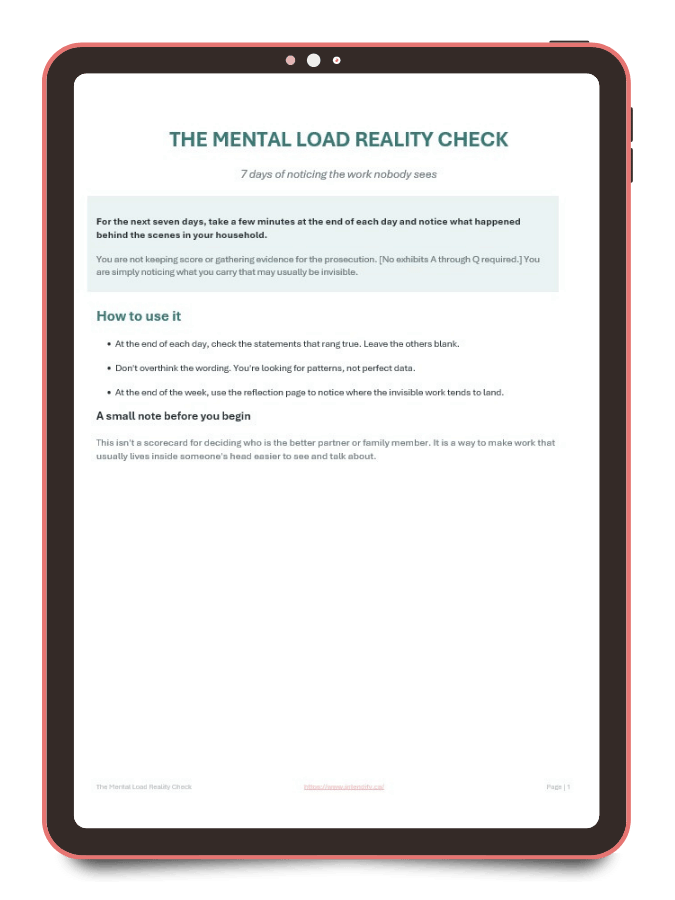
FREE Download - Mental Load Reality Check
Use it to make the invisible mental load visible so you can make it fair in your household.
For one week, you'll pay attention to things like reminding, anticipating, answering questions, solving problems, following up, and doing things yourself because asking someone else feels like more work.
If you live with a partner or other family members, print a copy for everyone. At the end of the week, compare what you noticed. You may discover that the load is more evenly shared than you thought, or you may finally be able to see why one person is feeling so exhausted and resentful.
Either way, you'll have something much more useful than assumptions to start the conversation.

Michelle Arseneault is a certified life coach and instructional designer who loves helping women understand why life feels harder than it needs to, and what to do about it.
“I believe small, thoughtful changes usually have a bigger impact than dramatic overhauls. Around here, you'll usually find me exploring the psychology behind everyday life, creating practical tools, or asking questions that help you see things from a new angle.”
You might also like…


Straightforward steps to reset your garden and your energy in the Fall season.