
Who are you? Figure out what your core values are
This article is designed to help you notice what matters most to you and how it influences your decisions.
THAT’s not coming off easily…
What are values?
Values are the things that matter most to you; the principles you want to live by, even when no one’s watching.
Think of your values as the “rules” that help you decide what feels right for you. They’re like the little guide inside you that helps you choose friends, activities, and ways of living that make you feel good and proud of yourself.
When you don’t know your values, life feels confusing. You end up saying yes to things you don’t actually want, doing work that leaves you with regret, or trying to fit into places that don’t feel comfortable. It’s a bit like walking in the forest without a map. You can keep moving, but it’s highly unlikely you’ll end up where you want to go.
When you do know your values, things get simpler. You understand what matters to you. Decisions don’t feel as heavy. You stop feeling pulled in every direction. And you start choosing things that actually match who you are on the inside.
“Your values don’t tell you who you “should” be; they help you see who you already are.”
Here are a few examples:
If freedom is important to you, strict schedules might feel uncomfortable.
If connection matters most, working alone all the time might feel lonely.
If growth lights you up, staying in the same spot for years might feel frustrating.
Your values don’t tell you who you “should” be; they help you see who you already are.
They’re the internal compass behind your decisions, habits, and priorities. But many of us are never actually taught how to name our values or check if our lives reflect them.
Instead, we pick up what we’re supposed to care about from our families, culture, or even social media, and try to build a life around that. Sometimes it works. But often, it leaves us feeling off: like we’re going through the motions or chasing things that don’t actually feel meaningful.
This space is designed to help you pause and get honest with yourself about what actually matters to you.
Andrea’s story (With permission)
When Andrea came to her session, she sat down and said, “I don’t understand why I’m so unhappy. My life is fine… but something feels wrong.”
So we started exactly where she was. I asked her to tell me about a normal day. She described her routine: wake up early, tidy the house, commute, work through her long to-do list, come home, get more chores done, collapse, repeat. As she spoke, her voice sounded flat, like she was reading instructions from a manual.
I asked, “When in your day do you feel most like yourself?”
She paused for a long time. Then she laughed a little and said, “Honestly? When I’m doodling on scrap paper during meetings. Which… probably isn’t the answer you wanted.”
But it was. That tiny detail opened the door.
We explored it gently. I asked, “What is it about doodling that feels good?” She said, “It’s the only time I don’t feel… boxed in.”
We followed that thread.
I asked about other times she felt that sense of ease. She mentioned helping a friend brainstorm ideas for her small business. She mentioned chatting with her sister about life. She mentioned visiting a weekend art market and feeling strangely alive the whole day.
Bit by bit, her values started to show up:
When she doodled: creativity
When she brainstormed with a friend: connection and creativity
When she visited the art market: authentic self-expression and, you guessed it, creativity
Once we named them, her eyes widened. She said, “I don’t have any of that in my life right now.”
So when I asked her for one small change she wanted to make this week, she didn’t hesitate. “I want one hour that isn’t for work or chores.” That was specific and doable, so we kept going.
I asked, “What would you actually enjoy during that hour?” She thought for a moment and said, “I’ve always wanted to try pottery.”
So her first experiment was just that: signing up for a beginner class. When she came back two weeks later, she said, “That class was the first time in a long time I felt excited.”
That was the turning point. Once she experienced how it felt to honour one value, it became easier to make the next small decision.
Why knowing your values matters
Most people don’t realize how much easier life feels when they understand what matters to them. When your values are clear, everyday decisions stop feeling like guesswork. You’re not trying to figure out who you should be; you’re choosing based on who you already are.

Here’s what tends to shift when someone gets clarity on their values:
Decision-making becomes simpler: You don’t debate every choice for days. You can look at your values and see whether something fits or doesn’t.
Boundaries feel more natural: It’s easier to say “no” when you understand what you’re protecting. And it’s easier to say “yes” when something genuinely supports your well-being.
Guilt loses its grip: When your choices line up with your values, there’s less second-guessing and less apologizing for taking up space.
Comparison quiets down: You stop measuring yourself against people who don’t share your priorities. Their goals aren’t your goals, and you finally feel the difference.
Your goals become more meaningful: Instead of chasing things because they make you look “successful,” you choose goals that feel like a good fit for your life, energy, and capacity.

Feeling pulled in too many directions? Your values can help you find your way.
When you're clear on what matters most, decisions become easier. You spend less time second-guessing yourself, chasing other people's expectations, or wondering if you're on the right path.
The Core Values Toolkit helps you discover the values that guide your choices, so you can build a life that feels more intentional and true to who you are.
How this toolkit can help:
Discover what matters most to you
Make decisions with greater confidence
Build a life that's aligned with your values, not someone else's expectations
Why values matter
Your values influence almost every decision you make, from your career and relationships to how you spend your time and money. When your choices align with your values, life often feels more fulfilling. When they don't, it's easy to feel restless or disconnected, even if everything looks "successful" from the outside.
What is it?
The Core Values Toolkit is a guided digital resource that helps you identify your personal values and put them into practice.
Knowing your values isn't about choosing a few inspiring words from a list. It's about understanding the beliefs and priorities that shape the way you want to live, work, and make decisions.
Through practical exercises and thoughtful reflection, you'll uncover the values that are uniquely yours and learn how to use them as a compass for everyday life.
How this toolkit can help
When you know your values, life doesn't automatically become easy, but it often becomes much clearer.
This toolkit can help you:
Make decisions with more confidence and less second-guessing.
Set goals that genuinely matter to you.
Recognize when something isn't aligned with the life you want.
Feel more comfortable saying "yes" to what matters and "no" to what doesn't.
Build a stronger sense of purpose in your everyday life.
Instead of wondering what you should do, you'll have a better understanding of what feels right for you.
What's inside
Inside the toolkit, you'll:
Explore a wide range of personal values.
Reflect on the experiences that have shaped what's important to you.
Identify the values that guide your decisions.
Learn how your values influence your relationships, work, goals, and daily life.
Create simple ways to use your values when making future decisions.
By the end, you'll have more than a list of values. You'll have a practical guide you can return to whenever life feels uncertain.
Why I created it
One of the first questions I ask many coaching clients is, "What matters most to you?" It's a surprisingly difficult question to answer.
Not because people don't have values, but because they've often spent years responding to other people's expectations without stopping to ask themselves what they truly want.
This toolkit grew out of those conversations. I wanted to create a resource that helps you slow down, reflect, and uncover the values that have been there all along, even if they've been buried under busy schedules, responsibilities, or other people's opinions.
Product details
PDF that you can print.
Letter size (8.5 × 11").
Instant digital download.
Download available for 30 days after purchase.
Digital product only. No physical item will be shipped.
Frequently asked questions
What are core values?
Core values are the beliefs and priorities that influence how you make decisions, build relationships, and define success. This toolkit helps you identify the ones that matter most to you.
What if I already have an idea of my values?
That's a great starting point. The exercises in this toolkit will help you explore them more deeply and learn how to apply them in everyday situations.
Can I revisit this toolkit later?
Absolutely. Your values often stay consistent, but the way they show up in your life can change over time. Many people find it helpful to revisit the exercises during major life transitions.
Ready to make decisions with more confidence?
When you know what matters most, it becomes easier to build a life that reflects it.
Discover your values and start living with greater intention today.
Knowing what your values are won’t instantly make your life exciting and wonderful. It simply gives you a steady starting point so you can make choices that feel intentional rather than reactionary. And once you have that foundation, the rest of the work, such as setting boundaries, building habits, and making plans and decisions, becomes easier to manage.
Knowing your values makes life easier, but actually getting started can feel confusing. And you might already have a few worries or doubts showing up. Let’s walk through the most common thoughts people have before they feel ready to do this work.
You might be thinking:
-
Many people feel this way because values feel like a big, abstract idea. When something feels too big, your brain freezes and waits for a clearer path. So the goal is to start small and make the process simple enough that your nervous system doesn’t check out halfway through.
Quick wins:
Start with three moments from your week that felt good and three that felt uncomfortable. Don’t overthink it. Write down the moments as they happened.
Why this works: Values show themselves through everyday experiences. When something feels good, a value is being honoured. When something feels uncomfortable, a value is being ignored or stepped on.Ask yourself one question at the end of each day: “What mattered most today?” Just one sentence.
Why this works: Your brain starts noticing patterns without getting overwhelmed by lists or definitions.Circle three things in your life that you care about most right now. Family, health, creativity, rest, stability, learning. Pick whatever feels true.
Why this works: Naming categories helps you narrow your focus before choosing specific values.
Resources that might help
Podcast: The Happiness Lab - Dr. Laurie Santos (episodes on meaning and purpose)
-
This thought shows up when someone has spent years in survival mode. Life responsibilities take over and you stop checking in with yourself. Your values did not disappear. They simply went quiet because everything else needed attention.
Quick wins
List three things that used to feel like “you” but haven’t shown up in your life lately. It might be a hobby, a personality trait, or something simple like being playful.
Why this works: Your past often holds early clues about your values.Notice where you feel the most tired in your day. Fatigue is often a sign of misalignment.
Why this works: Your body recognizes what isn’t working even when your mind is unsure.Ask yourself: “When do I feel even a small spark of interest or energy?” It might last only a moment. Pay attention anyway.
Why this works: Early sparks help rebuild your sense of identity one small piece at a time.
Resources that might help
Personal Values Assessment by Barrett Values Centre
Free online quiz
A quick tool that gives you insight into your current values and how they relate to your life satisfaction. Use with a grain of salt, but it’s a solid conversation starter.
-
Many people think there’s a right list and a wrong list. This isn’t true. Values aren’t a permanent tattoo. They can shift with life stage, health, parenting, career, or growth. You’re not locking yourself into anything. You’re simply noticing what matters to you right now.
Quick wins
Choose only two or three values for this season of your life. Not forever. Just this chapter.
Why this works: Reducing the pressure of deciding something ‘for life’ helps your brain relax, which makes figuring this out much easier.Ask yourself: “Which value would make my life feel even ten percent better if I honoured it this week?” Keep it simple.
Why this works: You focus on usefulness rather than perfection.Try one tiny action that supports one value. If you choose creativity, sketch for five minutes. If you choose rest, go to bed fifteen minutes earlier.
Why this works: You learn through experience, not theory.
Resources that might help
Book: *Designing Your Life by Bill Burnett and Dave Evans: In this book, Bill Burnett and Dave Evans show us how design thinking can help us create a life that is both meaningful and fulfilling, regardless of who or where we are, what we do or have done for a living, or how young or old we are.
Brené Brown’s Core Values List
A streamlined list of about 100 values from her “Dare to Lead” work. You’ll probably see some of your top ones here.
-
When values shift, people often worry something is wrong with them. In reality, shifting values are a normal response to major life experiences. Becoming a parent, going through burnout, changing careers, aging, or healing from something painful can all change what feels important.
Your values are allowed to grow with you.
Quick wins
Choose the values that fit your life right now rather than the ones that fit five years ago. Let go of the old list.
Why this works: You stop measuring yourself against a past version of you.Name what you’re craving most in this season: Peace, adventure, stability, creativity, space?
Why this works: Cravings are often early indicators of shifting values.Ask yourself: “What would feel like relief?” Not excitement. Relief.
Why this works: Relief helps you see where your values have already moved.
Resources that might help
Book: *Transitions by William Bridges: The essential guide for coping with the inevitable changes in life.
Reflection exercise: Your right-now reality
Most people want a clear plan when they begin values work, but the truth is, you only need one simple place to begin. Start with a short reflection that helps you see your real life on paper. Grab a journal and answer these questions.
Describe your current reality
Ask yourself:
Which parts of my life feel off or tiring?
Where am I forcing myself to keep going?
What do I keep saying yes to even when I don’t want to?
Which moments leave me drained or resentful?
Don’t judge your answers. You’re simply noticing where things aren’t lining up.
Describe your ideal
Then shift to this side of the picture:
When do I feel like the best version of myself?
What qualities or experiences do I want more of?
How do I want my days to feel?
What do I wish I had the freedom or confidence to choose?
Reflecting on these questions will give you a real starting point. You’re not deciding what your values are yet. You’re opening your brain to the concept of values, so the next steps feel natural instead of forced.
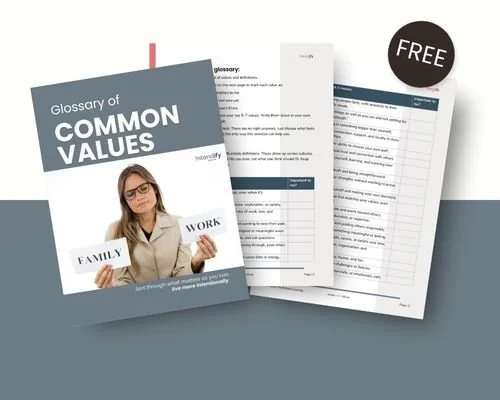
Start here: Identify your core values with the free Glossary of Common Values
You’ll get:
A short, curated list of real values (with plain definitions)
A sorting guide to help you figure out what fits you and what doesn’t
A reflection page to help you write your top values in your own words

Michelle Arseneault is a certified life coach and instructional designer who loves helping women understand why life feels harder than it needs to, and what to do about it.
“I believe small, thoughtful changes usually have a bigger impact than dramatic overhauls. Around here, you'll usually find me exploring the psychology behind everyday life, creating practical tools, or asking questions that help you see things from a new angle.”
You might also like…


Learn how to design and build a life that feels meaningful to you. This guide helps you get clear on what isn’t working, picture what you want instead, and take your first small steps with confidence. You’ll also find a free challenge and a guided workbook if you want deeper support.